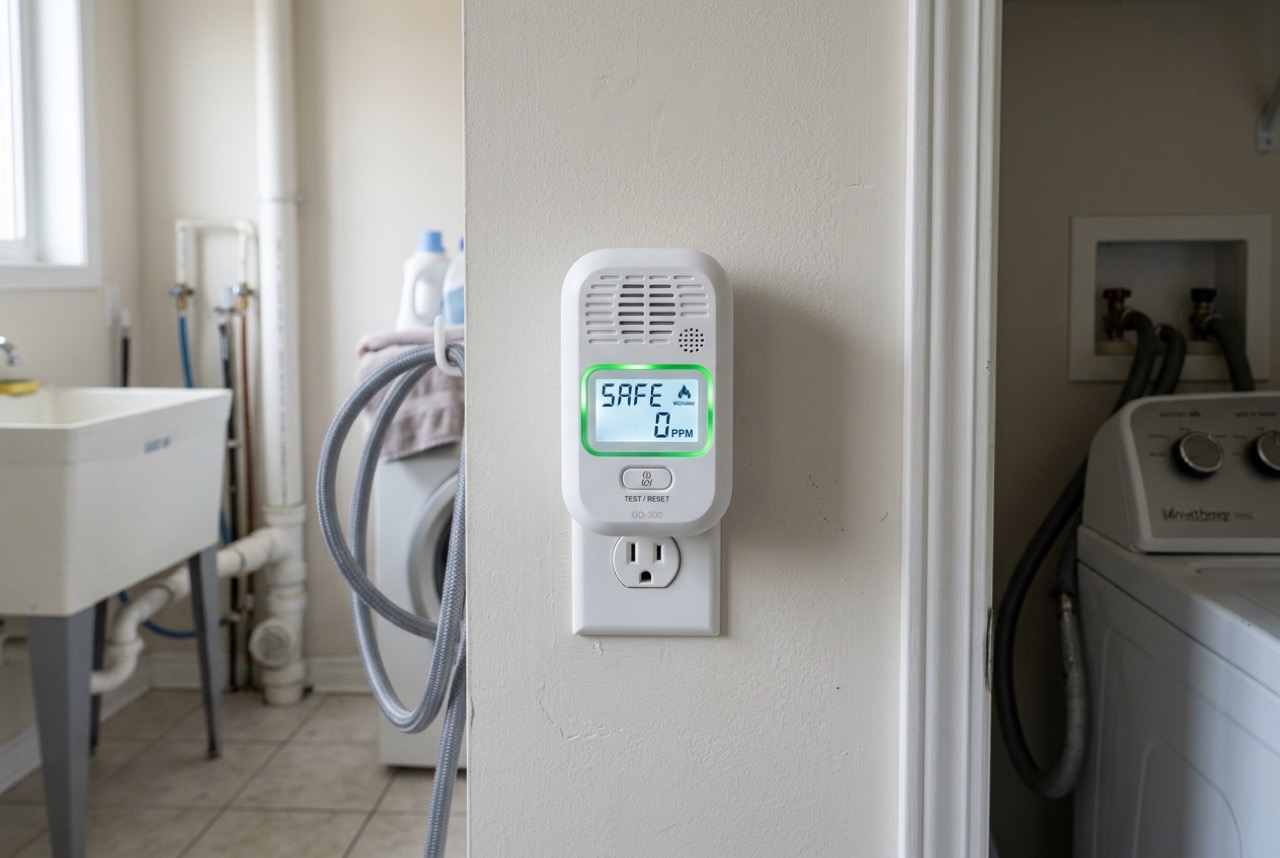
Carbon Monoxide (CO) vs. Methane (Natural Gas)
One of the most dangerous safety misconceptions among Northern Virginia homeowners is believing that their standard ceiling smoke/CO alarm protects them from natural gas leaks. A standard carbon monoxide alarm will NOT sound during a catastrophic natural gas leak.
Carbon monoxide (CO) is a toxic, odorless byproduct of incomplete combustion (e.g., a cracked furnace heat exchanger or blocked water heater flue). Natural gas, by contrast, is an unburned fuel composed primarily of methane (CH4), odorized with sulfur-rich mercaptan to smell like rotten eggs. To detect raw unburned methane, you must install an independent combustible gas detector.
Catalytic Bead Sensor Physics & Mechanics
High-quality combustible gas instruments and residential wall alarms utilize catalytic bead sensors (pellistors). Inside the sensor chamber, two microscopic platinum wire coils are configured in a Wheatstone electrical bridge circuit:
- The Active Element: Coated with a porous ceramic catalyst (such as palladium or platinum) and heated to roughly 500°C (930°F). When combustible methane molecules diffuse through the sintered metal flame arrestor, they oxidize (burn catalytically) on the bead surface. This microscopic combustion generates heat, increasing the platinum coil's electrical resistance.
- The Reference Element: A chemically inert bead that does not react with gas, compensating for ambient room temperature and humidity fluctuations.
The resulting electrical voltage imbalance across the bridge is proportional to the concentration of flammable gas in the room.
Combustible Gas Sensor Architecture & PPM vs. LEL Scaling
This technical cutaway demonstrates the internal catalytic bead chamber, flame arrestor filter, and digital alarm circuitry:
Combustible Gas Sensor Architecture & PPM vs. LEL Scaling
Internal schematic of a catalytic bead sensor chamber measuring Lower Explosive Limit (LEL) and digital parts-per-million concentration.
Understanding LEL Percentages vs. PPM
In air, natural gas will only burn or explode when its volumetric concentration is between 5% and 15%:
- 50,000 PPM (5.0% by volume): This is the Lower Explosive Limit (LEL). Below 5% gas in air, the mixture is "too lean" to ignite.
- 150,000 PPM (15.0% by volume): This is the Upper Explosive Limit (UEL). Above 15% gas, there is insufficient oxygen to support combustion ("too rich").
Under Underwriters Laboratories (UL 1484 standard), residential combustible gas alarms are calibrated to trigger a piercing 85-decibel alarm when gas reaches 5% to 10% of the LEL (approximately 2,500 to 5,000 PPM). This provides homeowners with ample warning to evacuate hours before concentrations approach explosive thresholds.
Where to Mount Natural Gas vs. Propane Detectors
Gas density dictates sensor placement:
- Natural Gas (Methane): Methane has a vapor density of 0.60, meaning it is significantly lighter than air. As gas escapes from a stove or pipe joint, it rises rapidly toward the ceiling. Mount natural gas alarms on an interior wall within 6 to 12 inches of the ceiling, and between 3 and 10 feet horizontally from gas appliances.
- Liquid Propane (LP): Propane has a vapor density of 1.50, meaning it is heavier than air and settles into low floor corners and basement sumps. Propane alarms must be mounted within 6 inches of the floor.
Did Your Combustible Gas Alarm Sound? Treat any sounding gas detector as an active emergency. Evacuate immediately and dial 911 from outside. After responders clear the house, call Ashburn Gas Response at (703) 312-2655 for precision sniffer diagnostics.