Recognizing Outdoor Underground Gas Leaks
Because natural gas is lighter than air (specific gravity 0.60 relative to air), gas escaping from buried lines percolates upward through soil pores and vents into the atmosphere. You can detect underground yard leaks through four distinct environmental indicators:
- Vegetation Die-Off: Methane displaces oxygen around plant root systems. Look for a distinctive localized patch of dead, yellowed, or brown grass directly over the pipe path while the surrounding lawn remains lush and green.
- Bubbling Puddles or Wet Ground: During or following rain, escaping pressurized gas creates continuous bubbling through standing surface water, mud, or saturated soil.
- Audible Hissing or Roaring: A ruptured yard pipe under 20–60 PSI utility distribution pressure produces a persistent hissing or jetting sound audible from several yards away.
- Blowing Dirt or Soil Eruption: Fine dirt, dust, or dry mulch being blown upward into the air without any wind indicates a high-pressure line puncture.
Public Utility Main vs. Private Customer Yard Lines
A crucial legal distinction governs underground gas lines. If a leak occurs in the street or between the street and the exterior utility meter, Washington Gas or Columbia Gas owns and repairs that pipe at no charge to you.
However, any buried gas pipe that extends after the gas meter is a private customer-owned line. In Ashburn, private yard lines are common for:
- In-ground swimming pool and spa heaters
- Detached garages and backyard workshops
- Outdoor kitchen barbecue islands and pizza ovens
- Permanent gas fire pits and patio tiki torches
- Whole-house backup standby generators (e.g., Generac, Kohler)
If your pool heater or generator gas line leaks, the utility will shut off and lock your meter, and you must hire an underground-certified master gas fitter to locate, excavate, and repair the line.
Underground Lateral & Tracer Wire Cross-Section
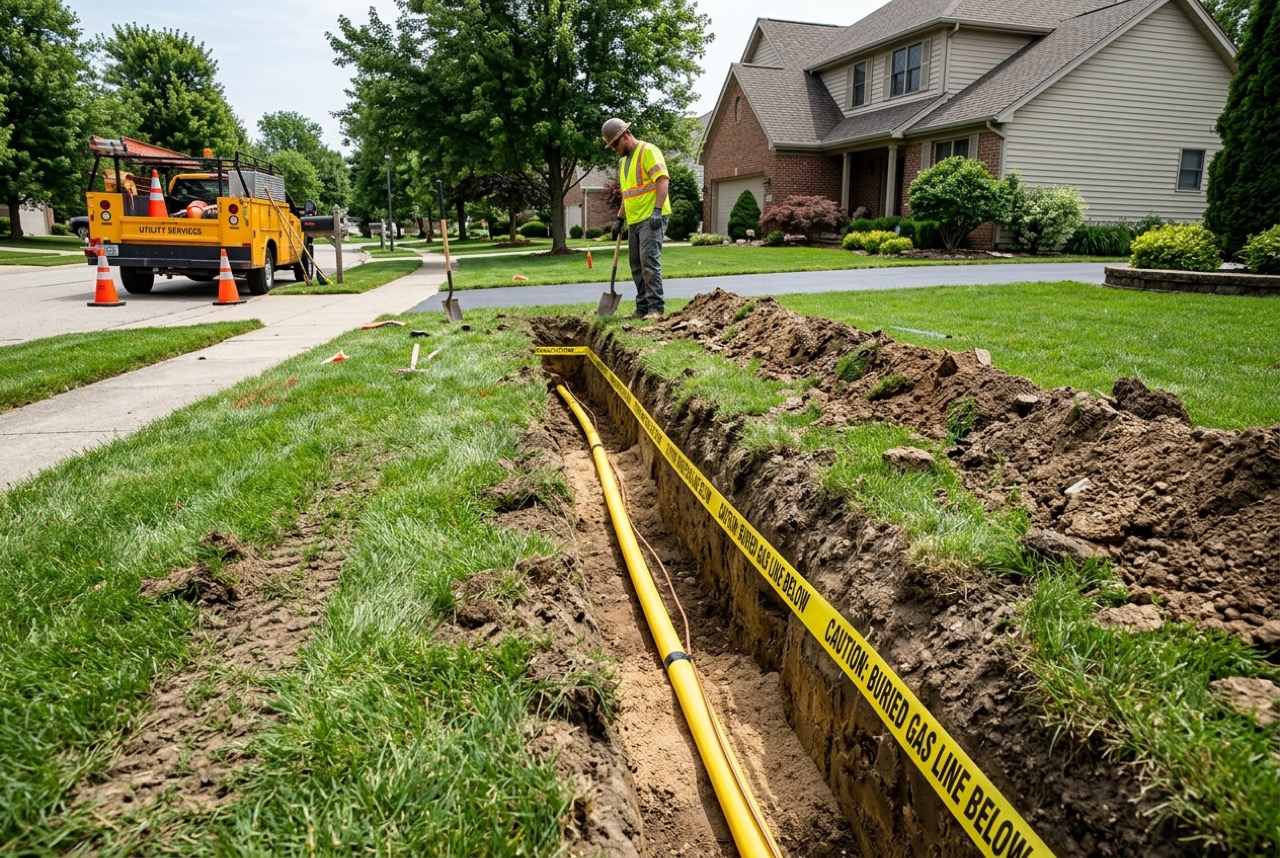
Virginia Fuel Gas Code requires strict burial depths, sand bedding, warning tape, and electromagnetic tracer wire for all private buried fuel piping:
Underground Polyethylene Gas Lateral & Tracer Wire Cross-Section
Engineering cross-section showing 24″ burial depth, warning tape, sand bedding, and yellow HDPE gas pipe with locator tracer wire.
Modern Polyethylene (HDPE) Piping & Electrofusion
Buried metallic pipes (black iron or galvanized steel) corrode rapidly in Virginia's acidic clay soils, leading to widespread rust pitting within 15–20 years. Modern code strictly mandates yellow Medium-Density or High-Density Polyethylene (MDPE/HDPE PE 2708 or PE 4710) for underground gas service.
HDPE cannot rust or corrode. To connect fittings, our technicians utilize electrofusion couplings or mechanical transition fittings with stainless steel internal stiffeners. Electrofusion couplings contain embedded electrical heating coils that melt the plastic together at 400°F, creating a joint that is chemically stronger than the pipe itself.
Virginia 811 Rules & Safe Trenching
Before any shovel breaks ground in Virginia, calling 811 (Virginia Utility Protection Service) is mandatory by law. Public utilities mark street mains, power lines, and telecom cables with spray paint (Yellow for gas, Red for electric, Orange for communication).
However, Virginia 811 does NOT locate private customer lines (such as your pool heater pipe). We utilize specialized electronic pipe and cable locators connected to the line's copper tracer wire to map private yard lines before excavation begins.
Suspect a Buried Gas Line Leak in Your Yard? Keep lawnmowers, motorized equipment, and open flames away from the area. Call (703) 312-2655 for precision underground gas line locating and repair in Ashburn.