Immediate Life Safety Rules (What NOT to Do)
If you enter your Ashburn home and smell a strong sulfur or rotten egg odor (mercaptan odorant added to natural gas), your only priority is immediate evacuation. Natural gas becomes explosive when mixed with air at concentrations between 5% and 15% (the Lower and Upper Explosive Limits).
In this critical window, any tiny electrical spark can ignite the entire volume. Follow these non-negotiable rules:
- DO NOT flip any light switches ON or OFF: The mechanical contacts inside standard wall switches create a microscopic arc that can detonate gas vapor.
- DO NOT use cell phones, landlines, or garage door openers inside: Walk at least 100 feet away into fresh air before placing any calls.
- DO NOT light matches, candles, or smoke.
- DO NOT attempt to open windows if the odor is strong: Opening windows wastes critical evacuation seconds and can create static electricity sparks. Leave the front door open behind you as you exit to allow air dilution, and proceed immediately to the sidewalk.
- From safety, dial 911 and Washington Gas at (800) 752-7520.
Common Indoor Leak Sources: Range, Furnace & Water Heater
Once emergency responders have ventilated the residence and verified safe air levels, our technicians pinpoint the mechanical root cause. In over 80% of indoor calls, leaks originate from three components:
1. Aging Corrugated Appliance Flex Connectors
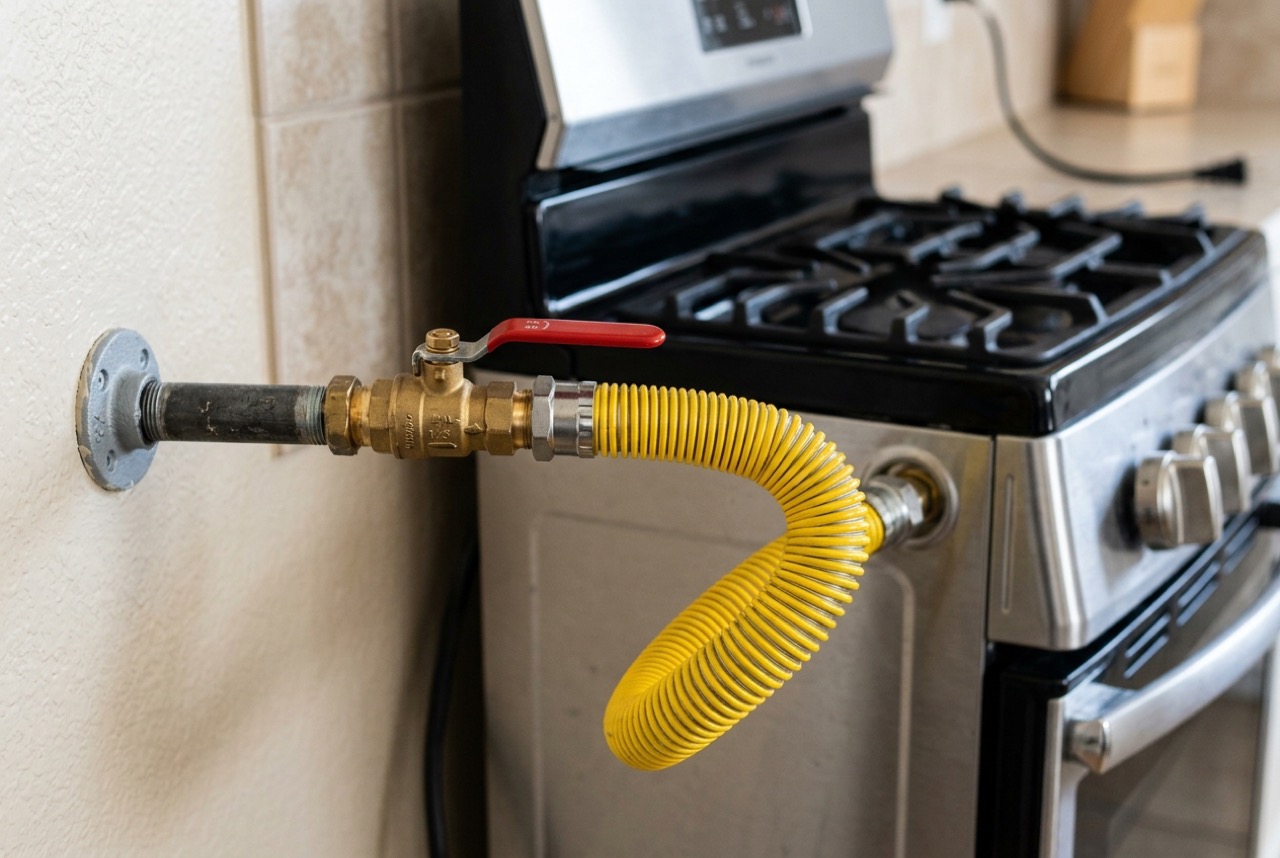
Flexible stainless steel gas connectors connecting kitchen ranges, clothes dryers, and water heaters are rated for a single installation. When appliances are moved for cleaning or flooring installation, work-hardening and repeated bending cause microscopic cracks along the corrugation valleys. Pre-1990 un-coated brass connectors are particularly dangerous and must be replaced immediately under Virginia code.
2. Gas Range Manifolds and Burner Valves
Dry valve stem packing on commercial-style ranges or loose brass flare nuts beneath cooktops frequently weep gas only when specific burners are turned on or off.
3. Furnace & Water Heater Combination Gas Valves
Basement utility closets house 24-volt electronic gas valves that cycle thousands of times every winter. Internal solenoid seat wear or loose sediment trap pipe unions release raw gas into the burner compartment.
Appliance Shutoff Valves vs. Main Meter Valve
Under Virginia Fuel Gas Code § 409.5, every gas appliance must have an individual, accessible quarter-turn shutoff valve located within 6 feet of the fixture and in the same room. If you smell gas isolated strictly behind your kitchen stove or next to your water heater, closing that specific yellow brass valve handle (turning it perpendicular to the pipe) will stop the local leak while preserving gas to the rest of your home.
However, if the odor is pervasive throughout the basement or crawlspace, the main meter valve outside must be shut off with an adjustable wrench.
Joint & Fitting Inspection Cutaway
Understanding how gas fitting joints are sealed and how electronic sniffers identify minute leakage points:
Threaded Black Iron Pipe Joint & Gas Sniffer Detection
Cutaway showing tapered NPT male/female thread seal, microscopic fissure path, and electronic sniffer sensor detecting PPM mercaptan gas.
Professional Appliance Re-Lighting & Flue Draft Test
Never attempt to relight gas appliances until the piping system has been formally certified by air pressure test. After completing repairs, our master gas fitters purge all trapped atmospheric air from the fuel lines to prevent burner rollout or backfiring.
We then inspect pilot assemblies, verify proper manifold burner pressure with a water column manometer, and conduct a chimney/flue spillage test to verify that combustion gases vent completely to the outdoors without carbon monoxide accumulation.
Smelling Gas Indoors Right Now? Follow the safety rules above and evacuate immediately. Once responders clear the home, call Ashburn Gas Response at (703) 312-2655 for certified repairs.